

In the Flat Switch Project, the objective is to validate the motion of flat switch and find out the problems in the working. The switch was small in dimension and there were many joints in the mechanism so identifying which part is causing failure was critical. eBHARAT developed a 3D model with all required mechanism. Understanding about GD&T and switch working helped eBHARAT team to identify root cause for non-functioning of design. ANSYS Rigid Body Dynamics tool used along CAD tool to simulate the working of switch. Structured approach and software tool expertise helped to complete the motion simulation of the flat electric switch in very less time. Solution to problem is approved & implemented successfully.

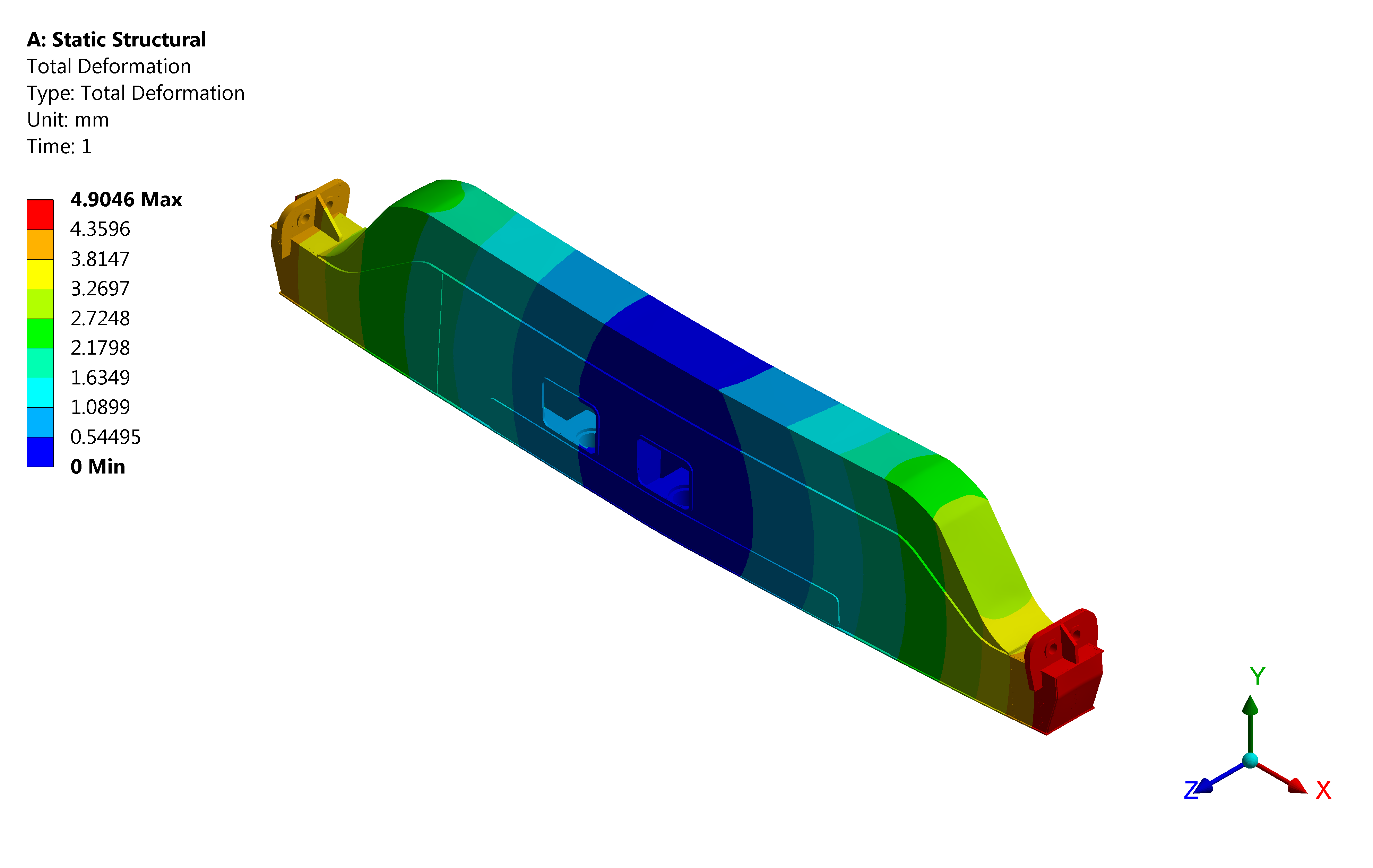
OEM of overhead crane received requirement of customized overhead beam with handling capacity of 5.8 Tones. End user of crane want to utilize the dead space between girder and roof to increase daylight of 1 m. The challenge for this design, a single girder to be design with two day-light heights. Due to requirements, the conventional design formulas were no longer valid. eBHARAT worked closely with OEM to get the solution. Based FE analysis and Design Iteration, eBHARAT suggested the design change to adopt two level of day lights. The revised design and FE results were accepted by end user. With expertise, OEM converted proposed design in reality, tested and delivered it successfully.

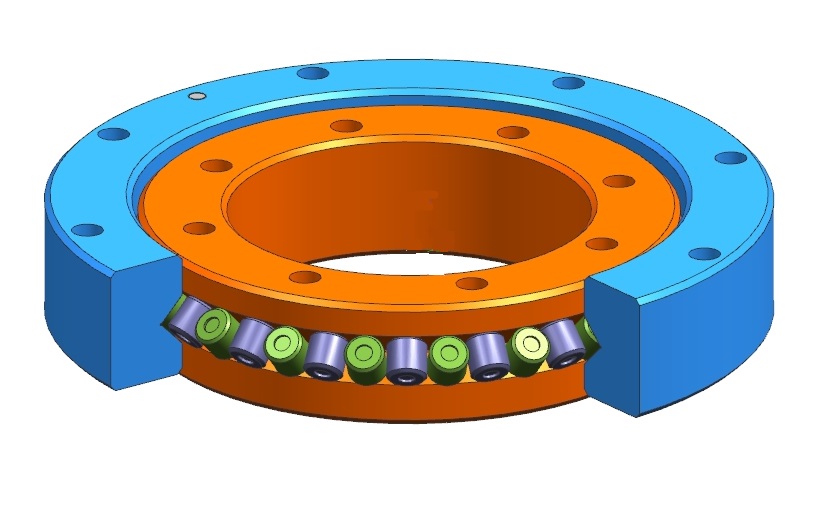
It is first product project development in alliance with SME executed successfully by eBHARAT. OEM approached for design validation and testing setup for already manufactured various range Spacerless Slew-Ring bearing. Being unique concept, which was patented later, many customers requested for design validation or testing of product for confidence building. eBHARAT performed 3D modeling, engineering, drafting and fatigue evaluation using ANSYS software. Also, eBHARAT played pivotal role for setting up testing facility, conducting test and co relating data with theoretical /CAE results. eBHARAT played facilitator role for technical writing and patent submission process.


The gate valve – NPS 10" is design as per ASME B16.34, ISO 110434 and API 600. The pressure inside valve ranges from 0 MPa (0 Bar) to 3.5 MPa (35 bar). Linear structural and Fatigue calculation performed to evaluate the fatigue life. The fatigue life is evaluated using ASME Section VIII Div.2. The calculated life of gate valve main body is checked against expected design life is 2 millions.


The evener beam is lifted by assembling D-shackle at two lifting points and rope arrangement using cranes. In simulation, effect of lifting rope and hook are represented by suitable boundary conditions. 3D brick elements are used to mesh the geometry. Static structural analysis is carried out to study deformations and Von-Mises stresses.


The mechanical design of supports and welds does not meet the criteria of ASME Section VIII Div.1 and Div. 2 Part 4. Therefore, the design is verified by performing FE analysis per rules of ASME Section VIII Div.2 Part 5. During first stage of analysis, local analysis is performed for supports. The regions not considered in analysis are represented using equivalent approach. The severe load combination is considered for second stage analysis i.e. sub-modelling analysis. For evaluation of design against plastic collapse, the stress linearization is performed at critical sections.


The analysis of this component poses challenge as the complex geometry is subjected to pressure and temperature transients along with loadings due to pipes. The analysis is carried out in a step by step approach wherein first the temperature distribution is obtained from thermal transient analysis. This temperature distribution is used as thermal load in static structural analysis which is performed at critical thermal gradients. As the manifold is classified as thick cylinder according to ASME Code based on thickness to diameter ratio, elastic-plastic analysis approach is selected to qualify code requirement. Local analysis approach is used which reduces computational time drastically. Multilinear Elastic-Plastic Material Model with Kinematic Hardening is used for analysis.


The 50KL blending tanks are installed for mixing of products like Maaza, MMPO, etc. The agitator shaft installed in such vessel, which is driven by motor gear box arraignment, has a primary function of homogenous mixing. We perform the failure mode analysis of agitator shaft as failures are observed during operation. The failures are mainly observed at the shaft mounting location where shaft is vertically suspended using a bolting arrangement. Also, failures are observed at the connection of upper solid shaft to lower hollow shaft. To address issues of failure, few modifications are carried in shaft mounting design.


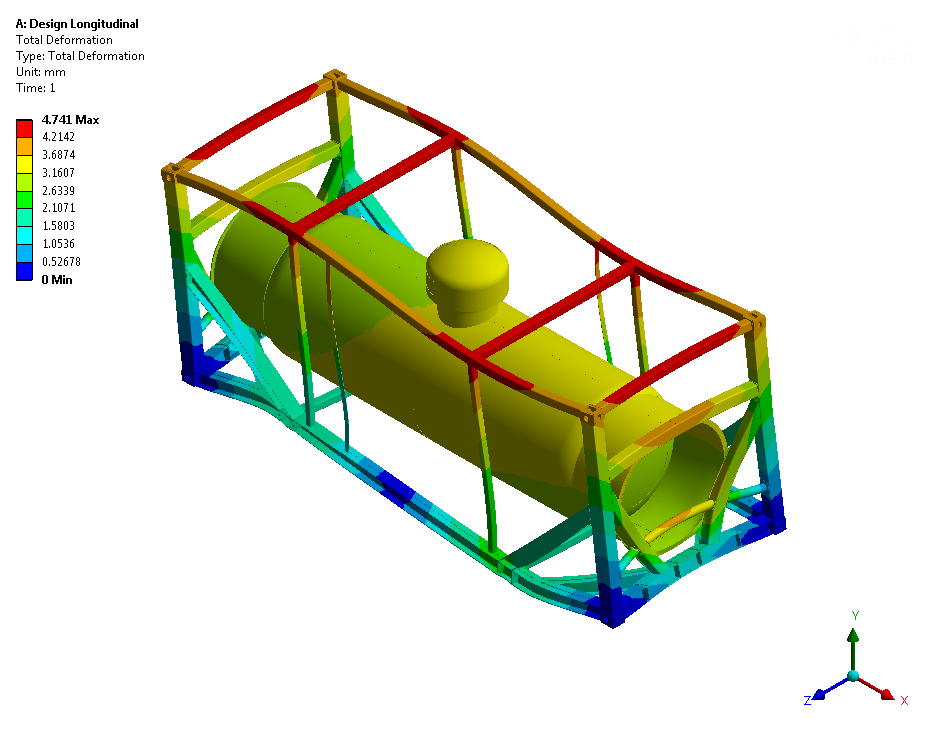
Design from manufacturer was to be analysis for various shipping loads. Testing cases of lifting and jacking along with longitudinal and lateral loadings were analyzed. In addition to these load cases, shipping loads like roll, pitch, heave were analyzed considering gravity effect. Modifications in design were carried out based on the results, to optimize the design with respect to weight of the frame.


Thermoelectric systems are used for measurement techniques (such as thermocouples etc.), for Peltier-cooling (such as CPU-Cooling, refrigeration, temperature stabilization etc.) and direct energy conversion of heat (such as TEGs, driven by waste heat, radioactive decay, combustion etc.). Performance of T-E material mainly depends on Seeback coefficient, thermal and electric conductivities.


Even though transient analysis gives accurate results, they are computationally expensive and highly non-convergent. Hence it is not always feasible to use transient analysis for large problems such as shock, seismic analysis. Time response analysis can give results in reasonable limits of the transient results in very less time.


In today's world, seismic analysis of a component or structure has gained a major importance because of the damage done by the earthquake in recent incidents. Qualifying the Rectifier unit under seismic zone 4 was a real challenge.

The concept design required an extensive brainstorming session along with the client to meet the design requirements of ISO standards. Preliminary calculations were performed based on which we arrived at a design, meeting all the manufacturing constraints and the standard. The design is unique in its own way compromising of all I-sections except the vertical box sections. The FE report was approved in one go by the International Approving Agency, Lloyds UK.

Performing threaded connection analysis is always a challenge. Based on the literature study, linear 3D FE analysis and theoretical calculation, a whole new 2D axisymmetric analysis methodology was developed to calculate the stress distribution and connection behavior.

Core team members of eBHARAT have personal service experience to perform calculation to meet the requirements of N and NS stamp. The vessel was analyzed for internal pressure, transient, gravity and seismic loadings.

The need for raking machine evolved considering the problems faced while poultry farmer was raking in poultry shed. A concept of special purpose Power Operated Raking Machine, PakshiMitra was developed which significantly reduced the time, efforts and helped to improve an effective raking process.

A root cause analysis for an observed leakage failure of Hydro Cyclone which was optimized for weight was done. It was a problem in the realm of multi-physics including pressure-velocity variations affecting its strength.

The criticality of this project was considerable as it incorporated 7 assemblies, 14 sub-assemblies and 3200 parts which needed to be modeled.

The need for a punch evolved considering the problems faced while cutting slots in the aluminum window frame. A concept of special purpose tooling was developed which significantly reduced the scrap, damaging of tubes and the operation time.